We need a new mythos
And I will give it to you

Art imitates life. Life imitates art. Fiction in general, and science fiction in particular, are powerful trend-setters of our shared mythos of the future.
A pivotal moment in American science fiction arrived in 1951 with Isaac Asimov’s Foundation, a work informed by the collapse of the Roman Empire. The Foundation posed an interesting question: What if we understood our society with the same predictive certainty as we understand the motion of planets? Could we defend against social catastrophes as we do structural failures or natural disasters? What are the Great Forces guiding history, and how might we tame them?
Frank Herbert’s Dune rejected the notion of predictable historical forces. Society, it argued, is propelled by Great Men, though not necessarily Good Men. It is their intricate plans and counter-plans that shaped destiny. Dune also introduced a prescient backstory of an AI uprising, a remarkable foresight for a novel published in 1965.
Shortly thereafter, the original Star Trek series (1966) premiered. Television and film granted fiction an unprecedented power to synchronize a cultural mythos across a mass audience within a short time.
Entire generations are subtly guided by the mythos of their formative years. The Boomer generation was profoundly influenced by early Star Trek, which married hopeful optimism with a curious disregard for the hard problems of resource allocation. Even the speed of light posed no serious obstacle to human exploration.
While positive visions in fiction are rare and welcome, this lack of concern for the practical question: “Who is paying for all of this?” likely contributed to the political attitudes that have saddled the United States with immense debt. The Boomer, Star Trek-inspired, about technological progress that could never go wrong, remains evident today in monikers like “Operation Warp Speed.”
Generation X was shaped more by Star Wars, which built upon Dune’s tradition of overthrowing a galactic emperor, while coloring its morality in more palatable shades of white and occasionally redeemable black. Star Wars took the idea of Great People and made them somewhat smaller. The Jedi were heroes, pilots, and space wizards, partly based on historical figures like the legendary pilot Richard Best, whose destruction of 2 Japanese carriers turned the tide of war into America’s favor. Yet, neither the Jedi nor the Rebellion’s leaders showcased a grand vision for a good society post-victory. The Rebellion was inherently good, and winning was all that mattered.
America has always had a complex relationship with the mythos of rebellion. The nation forged itself in opposition to the English crown, yet later re-forged itself by suppressing the rebellion of the South. The rebellious spirit of *Star Wars* found fertile ground in the American psyche. While Star Wars provided justifications for programs like the Strategic Defense Initiative, its cultural impact was so profound that it was invoked during the 2024 election cycle with
.
Mythos of rebellion later benefited the foreign policy establishment, which frequently painted non-compliant leaders as “dictators” and their opposition as “moderate rebels,” regardless of their
.
The wars in Iraq and Afghanistan were justified through many methods, some relying on the notion that military success would naturally be followed by a democratic epiphany, as if in a post-war credits scene. Domestically, political movements such as
frequently utilize Resistance imagery.
Rebellion against an Evil Empire was but one dystopian flavor available to Gen X. The Terminator (1984) franchise warned of runaway progress in AI, while Jurassic Park (1993) cautioned against biological meddling. A deeper amalgamation of dystopian warnings arrived with Warhammer 40,000. On one hand, it offered the rare sight of human leaders portrayed as preferable to the alternatives, which was a vision so unusual it had to be encased in irony as thick as a Space Marine’s armor. Yet, because this vision only had to compete with utter annihilation by space monsters, it never had to grapple with how we might move forward. What would our society look like in 40,000 years if we “only” had the void of space and our own shortcomings to conquer?
The Millennial generation continued the trend of awed by the power of AI while being wary of it in The Matrix, which prophetically framed the 1990s as civilization’s high point. Yet Millennials also took a break from sci-fi to admire The Lord of the Rings (2001), which for many triggered a nostalgic RETVRN: to paleo diets, to traditional gender roles. Some even dreamt of
. People in power were allowed to be good again. The franchise’s cultural dominance is evidenced by the combined market cap of companies with Tolkienesque names. Millennials also witnessed the power of rebellion in touchstones like Equilibrium (2002), where the governmetnt suppresses emotion, and V for Vendetta (2005), which aided the rise of the “Anonymous” aesthetic.
Zoomer culture inherited a vast menu of myths, most notably the Harry Potter franchise and the early Marvel phases. Similar to the Jedi, superheroes and wizards were Good, but Smaller than Great Men. Their special powers, obtained through magic, technology, or training, were wielded for less ambitious goals. Marvel heroes used their abilities to Protect the Status Quo from bad actors, culminating in a finale involving literal time travel to restore the Way Things Were. World-changing ambition in heroes, or even basic utilitarianism, was often marked as a sign of near-villainous hubris.
Marvel’s vision of societal forces was deeply conspiratorial. Worlds were controlled by countless secret societies with inscrutable objectives. Governmental agencies were perpetually vulnerable to infiltration. In many ways, this was a more realistic portrayal of large-scale social dynamics than Star Trek’s utopian dreams, yet it failed to provide a compelling vision of how power should function or protect itself from subversion.
The 2010’s also exposed their viewers to a variety of dystopias. You had a dystopia where people were divided by district(Hunger Games), divided by personality(Divergent), divided by gender(Maze Runner), except there was always one somehow special girl. You got racially tense dystopias with humans and robots (Bladerunner), humans and apes (Planet of the Apes), humans and aliens (District 9). I guess you could find the message of “maybe humans are the real monsters” exciting in case you missed it in Avatar or the ten times before that. While Avatar, bearing the soul a story of Dances with Wolves inside a pretty suit, made money, its cultural footprint was limited to a
being told from the perspective of the villain. This pretty clearly indicates a certain cultural demand for human characters that actually fight for their own kind.
We got fertility-focused dystopia (Handmaiden’s Tale), catch-all technology focused dystopia (Black Mirror), gaming dystopia (Ready Player One), and a variety of post-apocalyptic dystopias. Post-apocalyptic snow dystopia with trains (Snowpiercer), post-apocalyptic desert dystopia with cars (Mad Max), post-apocalyptic bunker dystopia with power armor (Fallout), and post-apocalyptic island dystopia with horses (Cloud Atlas). With the last one you also got a many-in-one deal with an additional pre-apocalyptic dystopia focused on the abuses in the Asian food industry. Of course, we also got a seemingly never-ending horde of post-apocalyptic zombie movies, a trope that just like vampires, refused to stay dead even though the fresh ideas had decayed.
The relentless parade of dystopian visions is not only tiresome but counterproductive. I suspect the internal motivation of many world-builders is to “warn” us about over-indexing on a certain technology or political path. A running joke on Twitter is, “A tech company creates the Torment Nexus from the famous novel *Don’t Create the Torment Nexus*.” However, if we take the assumption that tech companies are not as good as being “live players” as they think they are and that they are mimetically downstream from dystopian sci-fi, then the responsibility of the “Torment Nexus” creation actually rests on the people warning about it. Life does not heed the arts’ warnings; life just imitates it. There seems to be an unwritten taboo against creating positive worlds, even as we freely reminisce about an idyllic past. It brings to mind a communist saying: “The future is certain; the past is ever-changing.”
Because we are so awash in dystopias, we have only dystopian fictional elites to compare our real elites to. This creates two problems: first, a failure to recognize top-down, carefully planned improvement; second, a desensitization to actual horror because it is so commonplace in fiction.
The lack of positive portrayals of political or financial power leads people to act out negative stereotypes. The movie Wall Street (1987) spurred people to join Wall Street. Even during my days at Yale, it was strange to witness champagne socialists who built their identity on opposing finance, only to join it immediately after graduation. It is not uncommon for an effective altruist, beginning with concerns about AI safety, to end up joining or founding a company that others then warn against. It is equally ironic to see government officials or movie studio executives, who built their identity on “opposing power,” continue the same rhetoric once in power, long after it ceases to make sense. Our future mythos must restore balance to the portrayal of Force. While utopia may be too much to ask for, we can certainly ask for portrayals of the People in Charge as fundamentally good and proactive in their quest to advance society.
The other challenge of dystopias is that they create a demand for oppression. Young adults, primed to rebel against a terrible empire, found none that was easily recognizable from the movies. The supply of specific, cinematic oppression outstripped the demand for it from would-be rebels. So, it had to be invented. Concepts like “systemic racism,” “whiteness,” and “the patriarchy” became the justification for the Western world’s turn towards DEI.
Thus, the myths of dystopias led to and were in turn reinforced by the Great Awokening, a cultural lost decade of flawless girl-bosses easy on both the eyes and character development, alongside other aspects of the Message. While the Force Awokens (or was it Awakens?) was able to make money off the momentum of Star Wars’ cultural power, other attempts
to re-forge a timeless classic
crashed and burned harder than a volcano, leaving behind a desolate cultural wasteland full of angry fans and lost profits.
I have not perused much of the fiction that prompted the phrase “go woke, go broke,” instead relying on
to dissect “the Message” of these productions. Thankfully, the marketplace has finally signaled to studio executives that these so-called “modern audience” films are black holes of cash and credibility.
Thus, we have cosmic rays of hope in terms of both realism and philosophy. Quasi-hard sci-fi like The Martian, Gravity, or The Expanse portrayed the inhospitable environment of space as the enemy to be overcome with intelligence, courage, persistence, and the Will to Live. The Expanse is a particularly interesting example, combining realism with a quasi-dystopian warning. Its message is simple and correct: do not treat your workers badly if they are capable of military action. This is a lesson tax-hungry Western leaders would be wise to learn before the inevitable simplification of drone technology makes its way into civilian hands. The show also presents a society whose social technology has severely lagged behind its weapons technology. While this is a realistic reflection of our world, if humanity is to survive, we must expect this gap to eventually close. Thus, we need speculative accounts of how that might occur.
We are now able to relive the old debate of Great Men versus Great Forces through new visual adaptations of Dune and Foundation, even if filtered through the lens of modern sensibilities. Yet merely reliving old debates is insufficient; we must move past them. Across the Pacific, China has heroically entered the blockbuster arena with The Wandering Earth, a film that sacrificed a little plausibility for a great message: “We can just do things.”
While the American mindset of “I can just do things” powered individualistic market economies and tech startups, the challenges of the 21st century require a more collective approach. “We can just do things” mentality is central to solving collective problems like low fertility and economic over-financialization. While individualistic spaceship captains making their own in the void is certainly a “vibe”, the vast majority of space conquest needs to be done via megastructures: moon computers, O’Neil cylinders, giant telescopes. and space elevators. Maintaining a colony on the Moon or Mars is a collective effort. Yet it is hard to drum up excitement for such projects when the quintessential megastructure in our minds is a Death Star, and the underlying vibe of space colonies in fiction is one of exporting old problems to new frontiers.
What we need is a new mythos: more visions of futures that are both positive and realistic, not just for America, but for the world. We cannot rely on wishful thinking about breaking the laws of physics; we must work within them. We cannot punt our problems to a deus ex machina AI if we do not even know what success looks like. We can, however, slightly bend the rules of realism to tend toward optimism and answer the big questions. What if power didn’t corrupt? What if people in charge were, on average, good? How do we grapple with further advances in destructive technology? What would it take to portray a “White Mirror”, not a world where all technology is good, but one where we are careful to build good technology? What if we planned for the millennia required to colonize a new star?
A mythos is not a precise prediction for betting markets. It is an image of a possible future, sufficiently interesting to become the subject of a serious debate: “Do we want this or not?”
Creating a non-dystopian, yet realistic mythos is an immense cognitive challenge. It requires a sound understanding of the limitations imposed by physics, software, and biology. The more difficult portion, however, is coming to terms with the realization that modern social structures are ill-equipped for the complexity of long-term travel or planning beyond the next election cycle. To create a realistic, positive message, we must escape the 20th-century ideological cage of fascism/communism/liberalism. We must understand the fundamental forces that sustain society versus those that cause its collapse, and we must construct post-liberal governance models that are built from first principles or older functional ideas.
But above all, we must grapple once more with the questions of Goodness and Greatness. While we are not short on impressive warrior-heroes, we must refocus our mythos on the everyday Good Men and Women who tirelessly sustain civilization through work and family life. We must confront the question of Great leaders who are proactive in their plans and worthy of our trust. We must confront the question of Great Societies and the design of institutions that can orient ordinary people toward adding their individual effort to a grand, collective work. Pardon the slogan, but it is time to make fictional worlds Great Again.
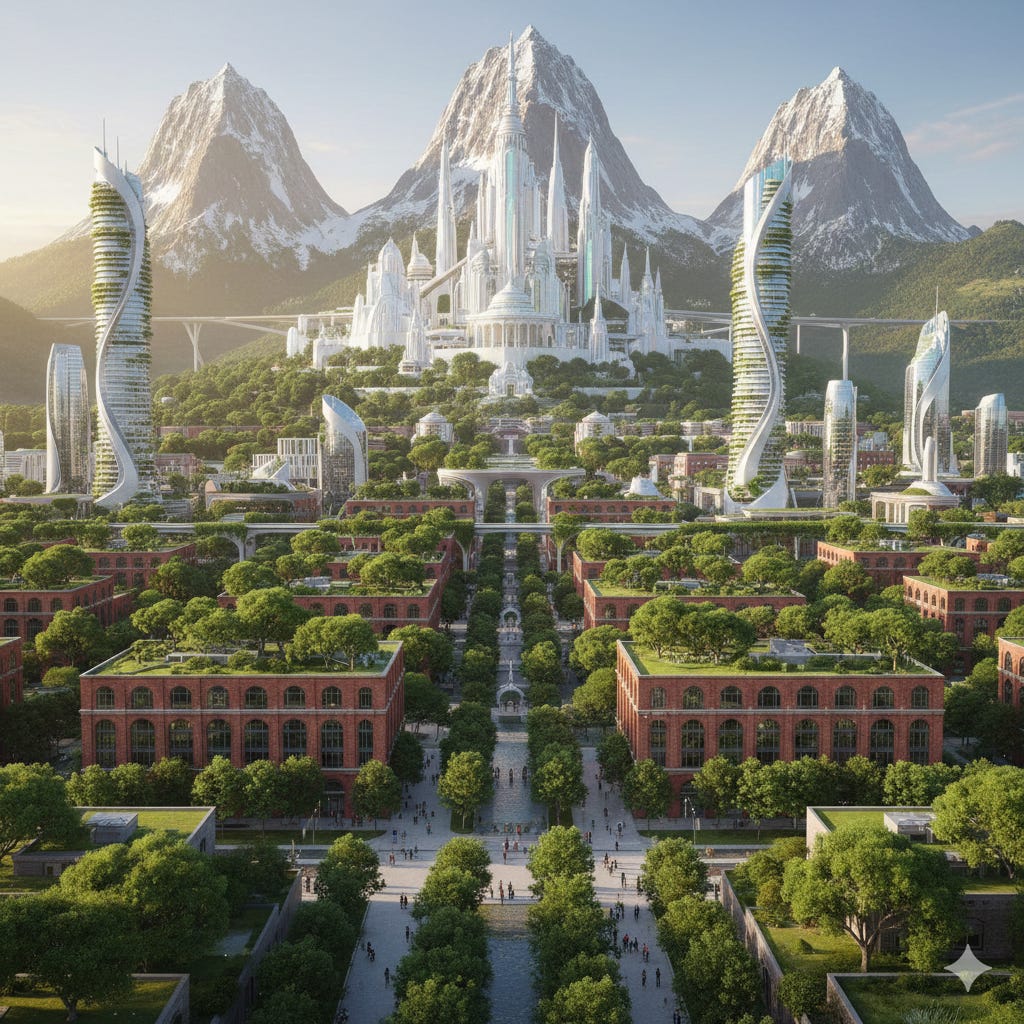
This call to action is no mere advice for others. I have decided that “I can just do things” and have begun working on such a mythos myself. My book,
Will of the Stars: First Contact
, was released on October 15th. I hope it inspires you.